
Published: 3 October 2026 | By Umair A R Mughal
Right after granting a 15-day extension for income tax returns, the Federal Board of Revenue (FBR) has made clear that extra time does not mean softer enforcement. On the instructions of the Minister of State for Finance, Bilal Azhar Kayani, the FBR has begun a nationwide, door-to-door market mapping operation from Friday, 2 October 2026. Teams will visit commercial markets in person and record every shop, alongside traders’ representatives, to push retailers into registration.
Why the FBR Is Doing This
The trigger is the poor response to the Asaan Tajir (easy tax) scheme, a simplified, fixed-tax route designed for small retailers. Over 10,000 shops have registered on the scheme’s mobile app, but only 778 returns have been filed under it so far, and just four of those came from retailers who were new to the tax system.
The minister’s message to the trade community was that retailers were given a scheme built around their own convenience, so there is no longer a good reason to stay outside the tax system.
The Gap: About 4.3 Million Retailers, 600,000 Filers
The FBR presented the numbers to the Senate Standing Committee on Finance on 30 September 2026:
| Item | Figure |
|---|---|
| Retailers in Pakistan (estimate) | About 4.3 million |
| Retailers currently filing returns | About 600,000 |
| Retailers outside the tax net | About 3.7 million |
| Target to bring in | 500,000 to 700,000 retailers |
| Expected voluntary registrations | About 200,000 |
| Shops registered on the Asaan Tajir app | Over 10,000 |
| Returns filed under the scheme | 778 (four from new retailers) |
Officials expect roughly 200,000 businesses to register voluntarily after the awareness drive, with the rest to be pursued through field enforcement. Minister Kayani told the committee that retailers have no option other than registration.
How the Market Mapping Operation Works
- Daily schedules. Each Regional Tax Office (RTO) prepares a daily schedule of target markets.
- Joint teams. FBR officers visit with representatives of local traders’ associations, which lowers confrontation and adds credibility among shopkeepers.
- Shop-by-shop recording. Teams record each establishment and its location, and brief shopkeepers on how to use the scheme.
- A first in-person visit. For many small traders, this will be the first time the FBR has come to their door rather than sending a notice.
The tone is facilitative, but the aim is enforcement. Once a shop has been mapped, it is no longer anonymous. A mapped business that keeps refusing to register or file can expect to be pursued through field enforcement.
The FBR has also removed one of the traders’ stated excuses. Retailers had complained about a technical problem with the “Other Income” column on the IRIS return form. That issue has reportedly been resolved.
New Electronic Invoicing Notification
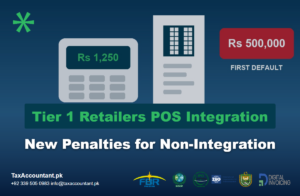
Alongside the field operation, the FBR issued a notification on electronic invoicing that mainly affects larger, already documented businesses, such as Tier-1 retailers, distributors and wholesalers integrated with the FBR’s system.
- Electronic sales tax invoices must also carry the particulars required under the Federal Excise Act, 2005 and the Islamabad Capital Territory (Tax on Services) Ordinance, 2001.
- Where sales tax, federal excise duty and ICT services tax all apply to one transaction, a single electronic invoice showing each tax separately is sufficient.
- A business already integrated with the FBR’s system does not need a separate technical integration just because it is also liable under those laws.
The enforcement side of digital invoicing is already running. Under the Finance Act, failing to comply with digital invoicing requirements can lead to suspension of a sales tax registration. See FBR Starts Suspending Sales Tax Registrations and FBR Begins E-Scrutiny of Sales Tax Returns. For setup help, see our FBR digital invoicing software and FBR integrated POS software.
The Extension Is a Grace Period, Not a Holiday
Retailers should read the timing carefully. The return deadline moved to 15 October after requests from trade bodies and tax bar associations, and amid heavy IRIS strain. It was not a relaxation of the FBR’s approach. See FBR Circular No. 03 explained.
Anyone who misses 15 October loses the old late-filer cushion. The late filer category has been abolished, so you are treated as a non-filer and face higher withholding tax on banking transactions, property deals and other transactions until you are back on the Active Taxpayer List (ATL). Getting back on the list now costs:
| Taxpayer | ATL surcharge |
|---|---|
| Individuals and sole proprietors | Rs 25,000 |
| Associations of Persons (AOPs) | Rs 50,000 |
| Companies | Rs 100,000 |
Small traders on the Asaan scheme face their own escalating late penalties: Rs 10,000 in the first month after the deadline, Rs 25,000 in the second, and Rs 50,000 in the third. See FBR Discontinues Late Filer Category.
Get Compliant Before the Mapping Team Arrives
The safest position for any retailer is to be registered and filed before the mapping team reaches your market. A business with a valid National Tax Number (NTN), a clean ATL status and an accurate Tax Year 2026 return has nothing to fear from a field visit.
The team at TaxAccountant.pk can register your NTN, set up compliant sales tax structures, manage your digital invoicing, and file your annual return well before 15 October. See our NTN registration services, income tax return filing services and ATL status check guide.
- WhatsApp / call: +92 339 505 0983
- Email: info@taxaccountant.pk
- Address: Office 1, First Floor, United Plaza, Main Service Road, Khanna Pull, Rawalpindi
Figures are as reported following the Senate Standing Committee on Finance briefing of 30 September 2026 and FBR statements of 2 October 2026, and may change.