Published: 26 September 2026 | By Umair A R Mughal
For decades, a tax audit in Pakistan meant a notice from your local tax office, repeated visits to meet the officer handling your case, and an outcome that depended heavily on who that officer was. That is about to change.
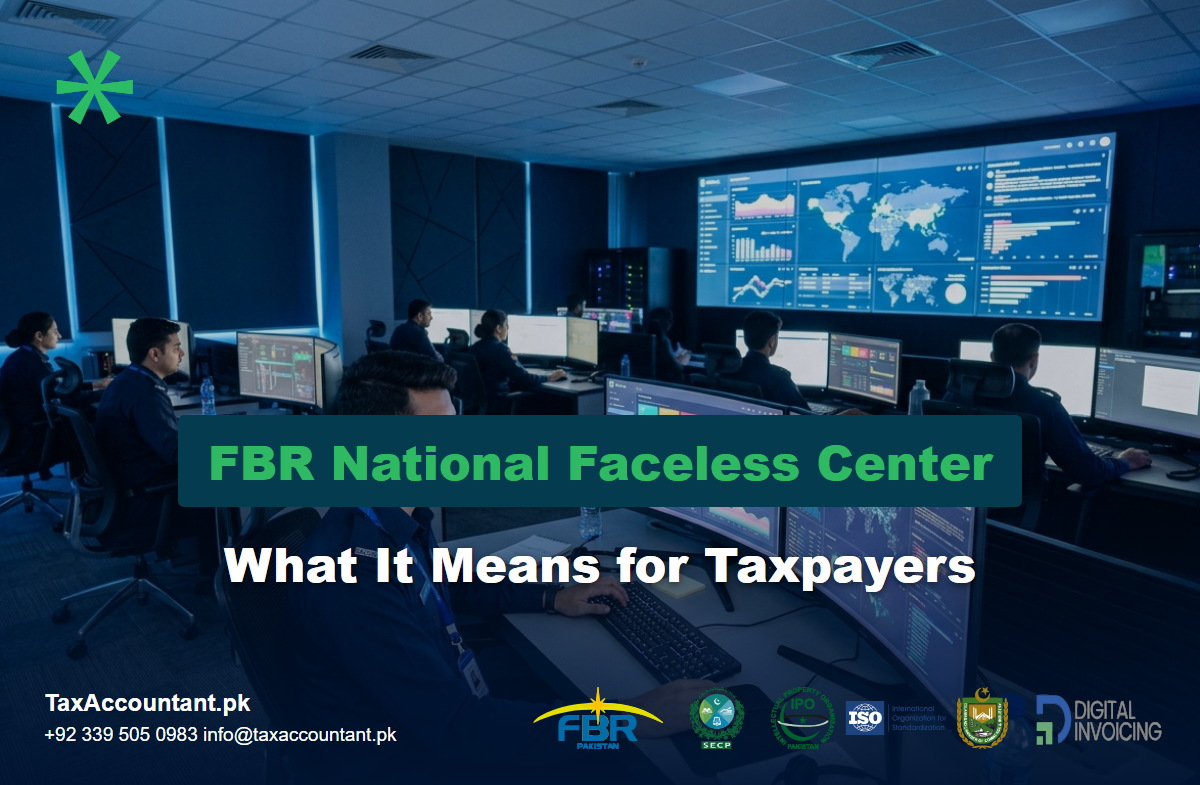
The Federal Board of Revenue (FBR) has established a National Faceless Center (NFC) in Islamabad. The officers who audit and assess your taxes under it are people you will never meet and whose identities you will not know. Everything will happen online. The center starts operations on 1 October 2026 and will initially focus on taxpayers whose spending exceeds their declared income.
Here is how the system works, who will be targeted first, and what you should do now.
What Is the National Faceless Center?
The National Faceless Center is a central unit that takes audit and assessment work away from local tax offices and handles it digitally. It was approved by the FBR Board, chaired by FBR Chairman Rashid Mahmood Langrial, on 25 September 2026. It is part of the New Tax Operating Model adopted in principle in June 2026.
Key Facts
| Item | Detail |
|---|---|
| Location | RTO Islamabad premises |
| Start of operations | 1 October 2026 |
| Led by | A Chief Commissioner Inland Revenue |
| Wings | Faceless audit, faceless valuation, quality control and field operations |
| Initial staff | 27 officers |
| Pilot scope | 300,000 to 400,000 individuals |
| Phase 2 | June 2027, moving audit and assessment work from all Regional Tax Offices to the center |
Pakistan joins countries already using faceless tax administration, including India (since 2019), the UK, Australia, the Netherlands and Singapore.
How Faceless Audits Will Work
The big difference is that one officer will no longer handle your case from start to finish.
- The system selects the case. Cases are picked from FBR data on a risk basis. Officers no longer choose whom to audit.
- The case is allocated automatically. It goes to an officer who could be anywhere in Pakistan. You do not know who, and the officer does not pick their cases.
- Three people work on each case. One officer scrutinises, another assesses, and a third checks quality before any order is passed.
- Everything runs through IRIS. Notices, replies and hearings are all electronic on the FBR’s IRIS platform.
- Field teams are separate. A separate field team handles physical verification or recovery only where the law requires it.
The aim is to limit officer discretion, reduce harassment and remove the openings for corruption that taxpayers have long complained about. The FBR is rolling out a similar approach for sales tax through its new e-scrutiny system.
Who Will Be Targeted First?
The pilot phase covers individuals only. Companies and Associations of Persons (AOPs) are excluded at this stage.
The center will use third-party data: FBR records drawn from banks, airlines, vehicle registration authorities, property registrars and similar sources. The first areas of focus are:
- Frequent or expensive air travel
- Purchases of luxury vehicles
- High-value property acquisitions
If you spend far more than your return and wealth statement show, expect a notice asking you to explain where the money came from.
What happens after a notice?
- If you can show acceptable evidence, such as a gift deed, sale of an asset, a loan, or income that was already taxed, the case is closed.
- If you cannot justify the spending, you will have to pay the tax due and amend your return.
What This Means for Taxpayers
Advantages
- No more office visits. You handle your case online, from anywhere.
- Less room for pressure or “settlements”. The officer does not know you and you do not know the officer, so the usual openings for corruption shrink considerably.
- More consistent decisions. Separate audit and assessment officers plus a quality review should reduce arbitrary orders.
- A written record. All notices and replies sit in IRIS, which helps if you appeal later.
Challenges
- Your documents speak for you. You cannot explain your position in person, so a weak or incomplete reply is judged exactly as submitted.
- Missing a notice is costly. Notices go to IRIS and your registered email. If your contact details are out of date, you can miss a deadline without knowing a notice was issued.
- Your wealth statement matters more. The FBR will compare your declared income and assets with your spending. Gaps in your wealth reconciliation will be the first thing it picks up.
- IRIS slowdowns. The system slows near deadlines, so submit replies early and keep proof of submission.
What to Do Now
With the center starting on 1 October, here is what to do now:
- Update your email and mobile number in IRIS so you receive alerts.
- Check your IRIS inbox regularly, not only when you file.
- Review your wealth statement. Make sure your cars, property and large expenses are declared and that any increase in wealth is explained by your income.
- Keep proof of the source of your money: bank statements, gift deeds, loan agreements, sale deeds and international remittance records.
- File your Tax Year 2026 return accurately and on time. The deadline is 30 September 2026. See FBR Tax Return Last Date 2026.
- Correct mistakes now. If you spot an error in your return, fix it before you receive a notice. It is always better to correct it yourself than to be caught.
- Get professional help with any notice. In a paper-only process, how you present your evidence makes a real difference.
Not sure what to keep? See the documents you need to file an income tax return.
Frequently Asked Questions
What is the FBR’s National Faceless Center?
It is a central FBR unit in Islamabad that conducts tax audits and assessments online. Cases are selected by the system and handled by officers the taxpayer never sees.
When will the National Faceless Center start working?
It is scheduled to start on 1 October 2026. Phase 2, moving audit and assessment work from all Regional Tax Offices to the center, is planned for June 2027.
Who will receive faceless audit notices first?
Individuals whose third-party data, such as air travel, luxury vehicle purchases or property deals, does not match their declared income. The pilot excludes companies and AOPs.
Do I have to visit a tax office?
No. Notices, replies and hearings are handled through IRIS. A field team goes out only where physical verification or recovery is required by law.
Can I find out who is handling my case?
No. Officer anonymity is a core feature of the system. Cases are assigned automatically, and three separate officers handle each one.
What if I cannot document my spending?
You will have to pay the tax due and amend your return. That is why it helps to keep proper records and close gaps in your wealth statement before you receive a notice.
Received a Faceless Notice? We Can Help
Our team at TaxAccountant.pk handles FBR notices, wealth statement reconciliation, return revisions and appeals. Under the faceless system, everything is done online.
- WhatsApp / call: +92 339 505 0983
- Email: info@taxaccountant.pk
- Address: Office 1, First Floor, United Plaza, Main Service Road, Khanna Pull, Rawalpindi
See our income tax filing services. Related reading: Penalty on Late Filing of Income Tax Return | Who Should File an Income Tax Return?
Based on public reports of the FBR’s decision on 25 September 2026. Details may change once the FBR issues a formal notification. We will update this post as more information emerges.