“I keep a little in each bank. Surely FBR can’t see all of it?”
We hear this a lot. Many Pakistanis spread their savings across three or four banks. Some do it for convenience. Some do it hoping no one adds it all up.
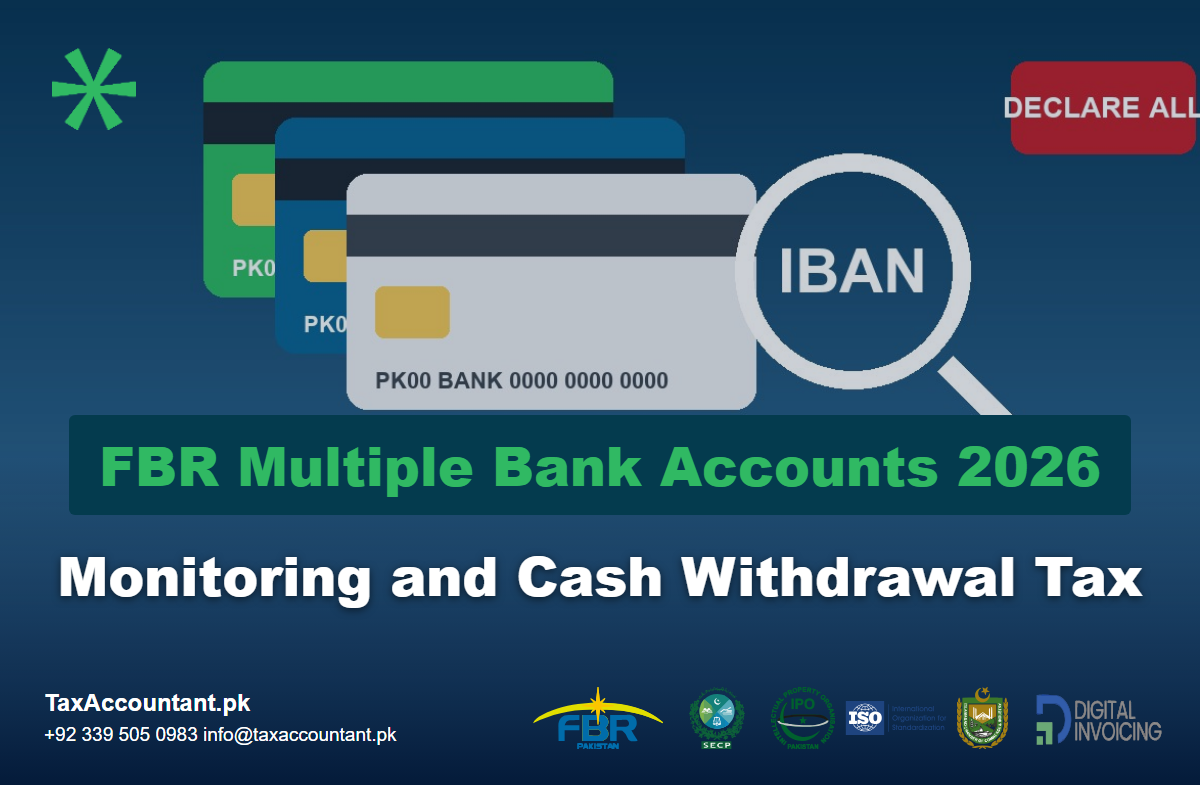
This year, that hope is fading fast. FBR is pulling banking data together more tightly than ever, and this year’s tax return asks for the IBAN of every account you hold.
If you have accounts in several banks, don’t panic. But do read this carefully.
What Is FBR Multiple Bank Accounts Monitoring 2026?
FBR Multiple Bank Accounts Monitoring 2026 isn’t one new system switched on overnight. It is several rules and data links working together.
Your CNIC ties everything together.
- Every bank account in Pakistan is opened against a CNIC.
- Banks share account holder details with FBR, including name, CNIC and address.
- Every bank on your CNIC can report any account to FBR.
Banks that already report
Sections 165 and 165A of the Income Tax Ordinance obligate banks to provide information to the FBR. This includes:
- Profit paid on deposits, and the tax deducted
- Cash withdrawals and the tax deducted
- Large transactions and balances
- Credit card payments
The IBAN requirement changes the game
The Tax Year 2026 return asked filers to give the IBAN of every bank account.
So FBR now has two lists:
- The accounts banks say you hold
- The accounts you declared yourself
The system can instantly see whether those two lists do not match.
Is FBR watching every transaction live?
Not in the way social media claims. We haven’t seen any official FBR announcement of live, transaction-by-transaction monitoring of every account.
But that hardly matters.FBR tracking of unreported bank accounts does not require live access. It only needs the bank’s records and your return, side by side.
Where that data goes
- FBR’s National Faceless Centre selects audit cases using third-party data.
- Its first focus is people whose spending and assets don’t match their declared income.
- An account you didn’t declare, holding money you can’t explain, is exactly what it looks for.
The Heavy Burden of Tax on Cash Withdrawal in Pakistan 2026
Here’s how the tax on cash withdrawal in Pakistan 2026 works, and who actually pays it.
Cash withdrawals by non-filers
- Applies under Section 231AB.
- Rate: 0.8% for people not on the Active Taxpayer List.
- It gets turned on when your total cash withdrawals cross Rs 50,000 in a day.
- If it is more than that limit, the tax is on the total for the day and not only what is beyond the limit.
- You can use it to withdraw cash from all your accounts and ATMs.
What it costs in practice
- Withdraw Rs 100,000 in a day: Rs 800 in tax.
- Withdraw Rs 500,000 for a wedding or a property payment: Rs 4,000.
- A shopkeeper withdrawing Rs 300,000 a week loses about Rs 2,400 every week.
Filers pay nothing
- If you’re on the ATL, no tax is deducted on these withdrawals.
- Non-filers can claim what was deducted as a credit when they eventually file.
What about transfers and cheques?
- Online transfers, cheques and cash deposits are not currently taxed under the cash withdrawal rule.
- Pay orders and demand drafts aren’t covered by it either.
- Disregard social media reports of a new tax on every transfer. Instead, refer to FBR’s official announcements.
Bank profit costs non-filers more.
- Tax deducted on profit from savings accounts is much higher for non-filers.
- Current rate cards show the non-filer rate at roughly double the filer rate.
Late filers are hit too
- From this year, the late filer category is gone.
- Anyone who missed the October 15 deadline is treated as a non-filer.
- They pay the higher rates until they file and pay the Rs 25,000 ATL surcharge (for individuals).
How to Declare Bank Accounts in FBR Return
Here’s how to declare bank accounts in an FBR return safely, so the numbers line up with what your banks report.
List every account
- Include current, savings, joint and foreign currency accounts.
- Include accounts you rarely use and dormant ones.
- Add the IBAN for each.
- Show the balance as at June 30 of the tax year.
Declare all the profit.
- Use each bank’s annual profit and tax certificate.
- Enter the profit as income, and claim the tax deducted.
- Missing profit is one of the most common mismatches FBR finds.
Claim your withholding tax
- Enter tax deducted on cash withdrawals, if any.
- Collect the bank’s withholding certificate for each account.
Reconcile the money moving between accounts
- Transfers between your own accounts are not income.
- Make sure they aren’t counted twice.
- Large inflows from outside need a clear source, such as salary, business receipts, a gift, a loan or a sale.
Make your wealth statement balance.
- Opening balances, plus income, minus spending, should equal closing balances.
- Don’t fill a gap with a large “cash in hand” figure.
- Bank statements, keep for the whole year in case FBR ask.
Joint accounts
- Declare your share, and make sure the other holders declare theirs.
- If the money is mainly yours, say so and keep the evidence.
Accounts in other people’s names
- Money kept in a relative’s or employee’s account to stay hidden is a serious risk.
- It can be treated as a benami arrangement.
- Bring it into your own name and declare it properly.
Forgot an account in your return?
- If you submitted your return within the last 60 days, you can generally alter your return without the Commissioner’s consent.
- Add the account, the balance and the profit.
- Correcting it yourself costs far less than having FBR find it.
What Happens If FBR Finds an Undeclared Account
- You may get a notice asking you to explain the account and the money in it.
- Section 111 lets you include and tax unexplained deposits as income.
- Section 182 false statements may be penalised.
- The case may be handled by the faceless centre, where your documents are your only defence.
Let TaxAccountant.pk Audit Your Banking Profile Safely
It’s entirely legal to keep your money in more than one bank.
Not declaring it is the problem.
At TaxAccountant.pk, we review your banking profile before FBR does:
- All accounts associated with your CNIC
- Balancing gains and profits with your bank certificates
- Matching significant inflows and transfers with your net worth statement
- Revising returns when an account is overlooked.
- Replying to alerts on unreported accounts
Let us make sure your return and your bank records tell the same story.