Thousands of people have filed rushed returns in the last two weeks. Now the same people are discovering errors that need to be corrected.
The FBR income tax return revision rules 2026 govern how easy or hard that is. The right timing is just a simple tweak. Wrong timing needs Commissioner permission Audit risk is another factor.
Final Hours Before the Income Tax Return Deadline 15 October
The Tax Year 2026 deadline is 15 October at midnight. There has been no further extension proposed or announced.
Across markets and offices that one question keeps popping up. “I have already filed, can I still make changes?”
Yes, but it depends on when you filed, what you are changing and whether FBR has already noticed.
How the FBR income tax return revision rules 2026 work
Revisions are included under section 114(6) of Income Tax Ordinance, 2001. No return is considered submitted unless four prerequisites are satisfied.
The justifications for the adjustment shall be stated in writing and signed.
Businesses may have to file amended accounting. This requirement can be waived by the Commissioner.
Your revised income shall not be lower than any income specified in an order of the FBR.
And you may need the Commissioner’s written approval. That last condition is where the timing comes in.
The 60 day window
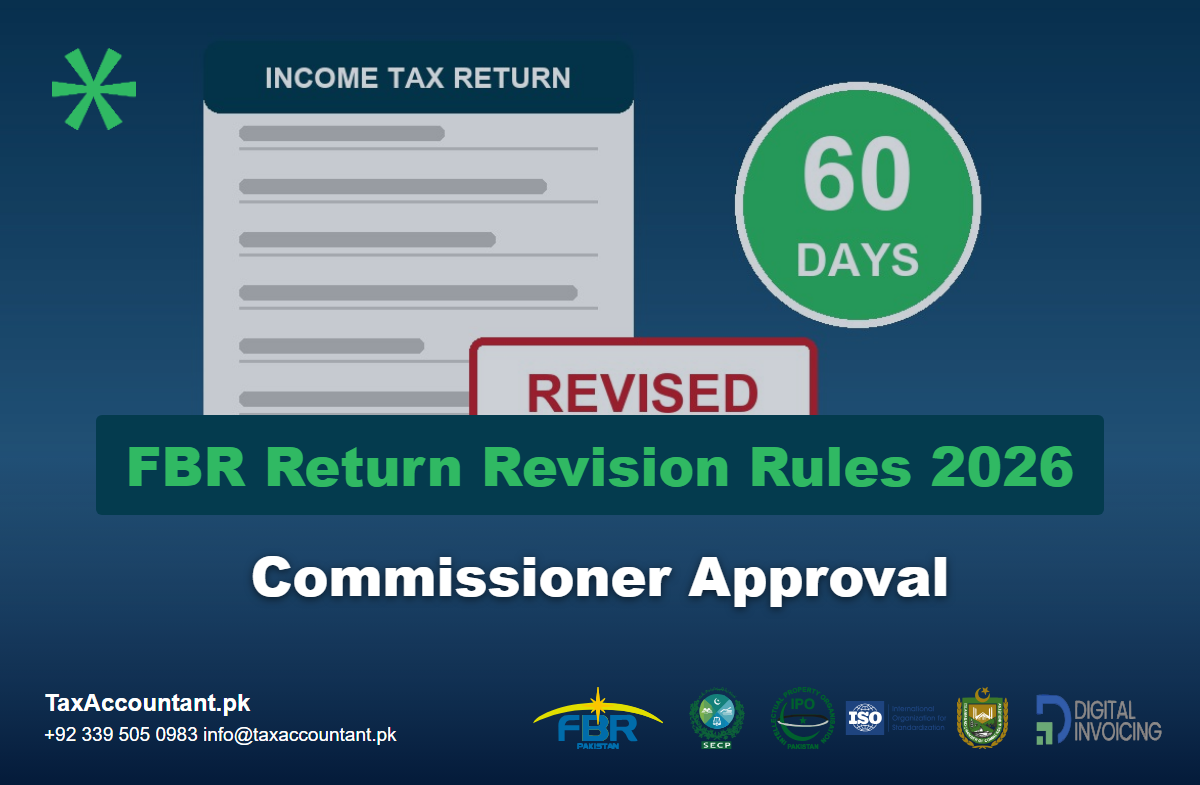
No approval is necessary if you revise your return within 60 days of filing your original return.
The 60 day count runs from the filing date, not from the deadline. So a return filed on September 20 can be revised freely up to mid-November.
After 60 days
Outside of the 60-day window you must apply on IRIS for approval before filing your revision.
There are protections built in.Where the Commissioner does not reply to your request for approval within 60 days after your request, it shall be presumed that he has approved it.
Your revisions are also regarded approved if they report greater income or less loss. The law directs approval to be given in the case of bona fide errors.
A new route under the Finance Act 2026
The Finance Act 2026 introduced Income Tax Ordinance, 2001 Section 114(6B). This applies when FBR’s new algorithmic settlement mechanism has offered a settlement.
If you accept that offer and pay the tax it calculates you can amend your return without approval. Most salaried individuals will not qualify for this route.
What this means if you filed in a hurry
If you filed your return in the last few weeks, you are almost certainly still within the 60-day window.
This means you do not need the Commissioner’s permission to make a correction of an honest mistake. You do need to act before FBR does.
Salary Tax Return revision for employees
A salary tax return revision is generally for minor omissions.
A second bank account is overlooked. Profit on savings is not declared. A plot or car is missing from the wealth statement.
Collect your documents first. These include bank certificates, the property deed and your employer’s tax certificate.
Correct the income section and the wealth statement together. Your assets, income and spending must reconcile.
Then file the revision on IRIS with your reasons, and retain the acknowledgement.
How voluntary correction saves money
Section 114(6A) offers an incentive to taxpayers who voluntarily make correction to their returns.
If you revise before you are selected for audit by FBR or issued a notice and pay the shortfall with default charges, there is no penalty. If you wait for an audit to point out the problem, 25% of the penalty is added. Waiting for a show-cause notice under Section 122(9) adds 50% to the penalty. Correcting early is always cheaper.
The Section 111 and automated audit risk
A revision is not a way to rewrite your finances after the fact. It has to be explained.
FBR’s systems automatically cross-reference returns with banking, property and vehicle data. Its new National Faceless Centre selects audit cases by computer.
A sudden surge in stated cash, or a huge asset with no source will be detected.
Under Section 111, assets that cannot be explained can be added to your income and taxed. This is why every revision needs supporting documents.
A well-documented correction closes a gap. A poorly explained one can lead to an investigation.
Revising does not fix a late filing
There is one thing a revision cannot fix. It cannot make a late return count as on time.
If you filed your original return after October 15, you are outside the new Active Taxpayer List. The late filer category has been abolished.
Active taxpayer list restoration then requires the Section 182A surcharge:
| Taxpayer | Surcharge |
|---|---|
| Individuals | Rs 25,000 |
| Associations of Persons | Rs 50,000 |
| Companies | Rs 100,000 |
The Section 182 late-filing penalty comes on top.
Until you are back on the list, non-filer rates apply. Cash withdrawals above Rs 50,000 a day attract 0.6% tax, and property and vehicle taxes are much higher.
The right order of steps tonight
If you haven’t filed, file a correct return before midnight. This avoids both the surcharge and the need to revise later.
If you have filed and found a mistake, check your filing date. If you are within 60 days, revise now while no approval is needed.
Either way, verify your status afterwards with our ATL status check guide.
Get a pre-submission check before midnight
A correct return tonight costs nothing extra. A late one or a badly explained revision can be much more expensive.
The FBR-registered consultants at TaxAccountant.pk review returns and wealth statements before submission. We also process requests to amend and approve returns already submitte