
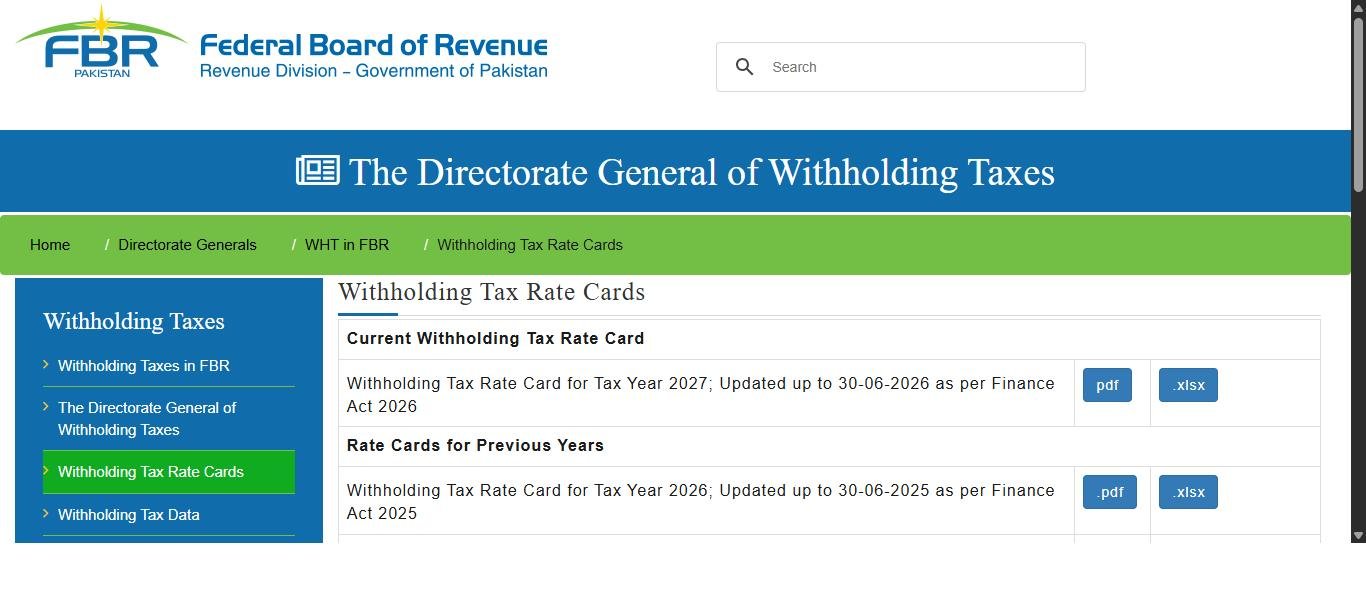
If you’re a salaried individual in Pakistan trying to estimate your income tax for the current year, the numbers changed under the Finance Act 2025 — confirmed on the FBR Withholding Tax Rate Card — most notably, the 9% surcharge that used to apply to salaried individuals with high income has been withdrawn entirely. If you’re using an older calculator or a guide with the 2023-24 slabs, you’re working from outdated numbers.
Salary Tax Slabs — Tax Year 2025-2026
| Annual Taxable Income (Rs.) | Tax |
|---|---|
| Up to 600,000 | 0% |
| 600,001 – 1,200,000 | 1% of the amount exceeding 600,000 |
| 1,200,001 – 2,200,000 | Rs. 6,000 + 11% of the amount exceeding 1,200,000 |
| 2,200,001 – 3,200,000 | Rs. 116,000 + 23% of the amount exceeding 2,200,000 |
| 3,200,001 – 4,100,000 | Rs. 346,000 + 30% of the amount exceeding 3,200,000 |
| Above 4,100,000 | Rs. 616,000 + 35% of the amount exceeding 4,100,000 (plus 9% surcharge if income exceeds 10,000,000) |
What Changed From Last Year
The single biggest change for salaried individuals is the removal of the 9% surcharge that previously applied on top of the calculated tax for high earners. That surcharge still applies to Associations of Persons (AOPs) and non-salaried individuals with taxable income above Rs. 10 million — so if you’re a salaried employee, you no longer pay it, but if you also run a sole-proprietor business or freelance income above that threshold, check whether it applies to that portion.
Pensioners under age 70 follow the same slab structure as regular salaried individuals, with no surcharge — this hasn’t changed.
How to Actually Calculate Your Tax
Find your annual taxable income bracket in the table above, then apply the formula shown. For example, someone earning Rs. 3,000,000 annually falls in the 2,200,001–3,200,000 bracket: tax = Rs. 116,000 + 20% of (3,000,000 − 2,200,000) = Rs. 116,000 + Rs. 160,000 = Rs. 276,000 for the year.
Remember this is calculated on taxable income — after any applicable deductions and exemptions, not your gross salary. If your employer withholds tax monthly, the amount should be roughly this annual figure divided across the year, adjusted as your salary or bonuses vary.
Other Calculators on Our Site
If you’re not salaried, or need to calculate a different type of tax, we have dedicated calculators for Company Income Tax, Capital Gains on Property, and Capital Gains on Securities.
Want your actual return checked by a professional rather than relying on a self-calculation? See our Income Tax Return Filing Services or get in touch via our contact page.
FAQs
Do these slabs apply to freelancers and self-employed individuals too?
No — freelancers and sole proprietors without salary income fall under the AOP/non-salaried individual slab structure (Section 18), which still includes the 9% surcharge above Rs. 10 million taxable income. The slabs above are specifically for salaried individuals under Section 149.
My employer is still using last year’s rates — what should I do?
Flag it with your HR/payroll department directly — under-withholding means you’ll owe the difference at filing time, and over-withholding means you’re owed a refund you’d have to claim. Either way it’s worth confirming your monthly deduction matches the current-year slabs.
Does this include provincial income tax or just federal?
This is federal income tax under the Income Tax Ordinance. Salaried individuals generally don’t have a separate provincial income tax, unlike sales tax on services which is provincial.