Why Your Sales Tax Return Shows an Unexpected Figure
If you’ve noticed an amount showing under ST-Return Clause 7a on a Sales Tax Return that you didn’t expect to see, it’s unlikely to be due to errors in your own Sales Tax Return. It means one of your buyers or suppliers haven’t submitted their Sales Tax return for the corresponding period and IRIS is highlighting the unpaid tax on your Sales Tax return due to your dealings with them.
How Clause 7a, 7b, and 7c Actually Work
These three clauses are effectively tracking the same issue as it progresses and is resolved:
- Clause 7a – If a buyer or supplier has not submitted their Sales Tax return for a period the unpaid tax associated with your transaction with them is shown here, on your Sales Tax return.
- Clause 7c – When a buyer or supplier has paid the outstanding tax shown under their Clause 7a, the amount paid is shown here on their return.
- Clause 7b – Where a non-compliant buyer or seller has paid the outstanding tax at a later date, the amount is credited back to the corresponding party, being deducted from Clause 7c, and shown here instead.
In essence: 7a is a flag that something’s unpaid on the other side of a transaction, 7c is what happens when it is paid, and 7b handles the credit-back when a late payment comes in.
The Practical Impact
The corresponding buyer or supplier cannot submit their Sales Tax return until they clear the tax in their Clause 7a. This enforces supply-chain compliance, with FBR flagging up if one party in a chain of transactions fails to pay their share, which becomes visible on the return of the party linked to them.
This means if you’re seeing an amount under Clause 7a it’s not something you need to deal with on your own Sales Tax return (unless there’s a mistake in your Annex-A or Annex-C) – it’s on the other party (your buyer or supplier) to file and pay what they owe for that period.
What To Do If You See a Clause 7a Amount
- Ensure which transaction it’s associated with and cross-check the amount against your Annex-A or Annex-C to identify which buyer or supplier it’s associated with.
- Contact the corresponding party. As it’s reliant on them to file their return and pay, a direct conversation is probably the quickest way to get it out the way.
- Don’t assume it’s a mistake on your part, double-check your own invoice entries are correct. But know that the likely cause is non-filing of a return by a party connected to you and not an error in Annex-A or Annex-C.
- Keep an eye out for it to move to Clause 7c or 7b when the other party pays – it’s the system confirming that the issue has been resolved.
Why This Matters Before You Submit
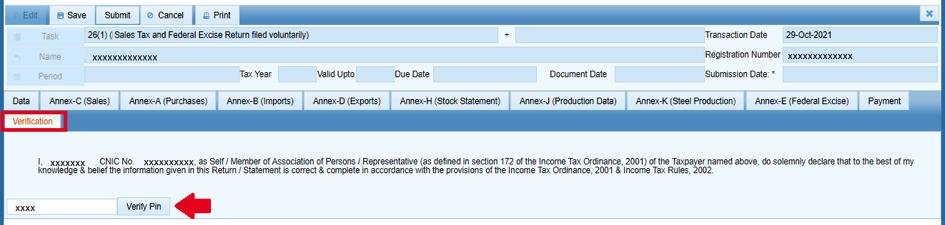
A Sales Tax Return locks once submitted. So it’s worth understanding your Clause 7a figure before submitting (rather than after) a return if it’s associated with a supplier relationship you can influence to file promptly and resolve any complications before your filing deadline. See our guide to Sales Tax return filing for the full process from log in to submission.
FAQ
Is a Clause 7a amount always my fault?
No, it reflects a buyer or supplier’s unpaid tax on a transaction related to yours, not an error in your own Sales Tax Return.
Can I remove a Clause 7a amount myself?
No, it’s cleared when the corresponding party pays their outstanding tax and submits their return. There is no action on your own Sales Tax Return to remove it.
What’s the difference between Clause 7b and 7c?
Clause 7c shows tax paid by the non-compliant party after their Clause 7a flag appeared. Clause 7b is the application when a late payment incurs a credit-back to the corresponding party, deducted from what’s shown in 7c.